Pittsburgh Winter Driving Guide
How to get through a Western Pennsylvania winter with less drama: what the roads do, what quattro® does about it, and the three things to check before the first snow.
What a Pittsburgh winter actually does to a road
Pittsburgh does not get buried. It averages a little under 30 inches of snow a year, which is less than Buffalo gets in a bad month. What makes winter here hard is the combination: hills, bridges and water, with the temperature crossing 32 degrees a dozen times a week.
- Bridges freeze first. Cold air moves under a bridge deck as well as over it, so the Sewickley Bridge, the Fort Pitt Bridge and the ramps onto the Parkway ice before the road on either side. Count the bridges on your commute; that is how many ice patches you cross before 7 a.m.
- Hills turn slush into a problem. A dusting that is harmless on a flat road in Cranberry Township is a stuck car on Blackburn Road, Negley Avenue or anything in Mt. Lebanon. Two-wheel-drive cars spin on the way up and slide on the way down.
- Freeze-thaw. Snow melts at noon, runs across the road and freezes at 5 p.m. Black ice shows up on Route 65 along the river and on the shaded side of every hollow in Sewickley Heights.
- Salt and brine. PennDOT and the city pre-treat the main routes, which keeps I-79, I-376 and Route 28 passable but leaves side streets and driveways on their own.
What quattro® does about it
quattro® is Audi’s all-wheel drive, and Audi has been building it since 1980. In plain terms: the system watches how much grip each axle has and sends engine torque to the wheels that can use it, usually before you notice a slip. On a Pittsburgh hill that shows up three ways.
- Starting on an incline. Pulling out of a driveway onto a snowy side street, all four wheels push instead of the front two spinning. Hill-hold assist keeps the car from rolling back while you get on the throttle.
- Keeping a line through a curve. On the bends of Ohio River Boulevard or the S-curves on Route 51, torque shifting between the axles helps the car track where you point it instead of plowing wide.
- Mixed surfaces. One wheel on packed snow, one on wet pavement, two on salt: quattro® keeps adjusting so the car does not twitch when the surface changes.
What quattro® does not do is shorten stopping distances. That is the tires’ job, which is why the next section matters more than people think.
Every new Audi Q3, Q5, Q7 and Q9 at Audi Sewickley comes with quattro®. The exact system varies by model (the Q5 uses quattro® with ultra technology, which disconnects the rear axle on dry highway to save fuel and re-engages in milliseconds), and our sales team can walk you through the differences on a test drive.
Before the first snow: tires, battery, visibility
Three things to handle before the first real snow, in order of how much they matter.
- Tires. All-season tires in good condition handle most Pittsburgh winters on the main roads. If you live up a hill, drive before the plows, or head to Seven Springs or Hidden Valley on weekends, dedicated winter tires are the single biggest upgrade you can make. Check tread depth now: below 4/32 of an inch, a tire is already losing its snow grip. Our parts department can quote a winter set for your Audi and store your summer wheels.
- Battery. Cold cuts a battery’s cranking power. A battery that was fine in October is the one that fails in the Giant Eagle lot in January. A load test takes a few minutes during any service visit.
- Wipers, washer fluid and lights. Salt spray on Route 28 empties a washer reservoir in a week. Switch to a winter-rated fluid and replace wiper blades that streak.
Two habits that cost nothing: clear the whole car, roof included, before you pull out (Pennsylvania law lets police cite you if snow or ice flies off your vehicle and injures someone), and leave twice the following distance on bridges.
When driving during winter weather conditions, ensure that your vehicle is equipped with appropriate all-season or winter tires. Always drive in a manner appropriate for the weather, visibility and road conditions.
The routes everyone asks about
A few local routes and what to expect on them once it turns cold.
- Ohio River Blvd (Route 65), Sewickley to the North Side. Mostly flat, mostly treated, but shaded stretches near Emsworth and Bellevue hold ice into mid-morning. Watch the lane that crowns toward the river.
- I-79, Cranberry to the Fort Pitt Tunnel. The best-maintained road in the region, and still the first to see lake-effect squalls coming down from Mercer County. Visibility drops faster than the surface does.
- Route 28 along the Allegheny. Wet year-round from river fog, and the on-ramps at Etna and Millvale are where cars spin. Merge with momentum, not with a stop.
- Blackburn Road and the climb into Sewickley Heights. Steep, shaded and narrow. This is the road that sells quattro® to our neighbors every January.
- The Parkway East and the Squirrel Hill Tunnel. The approach is a downhill curve onto a bridge. Slow before the curve, not in it.
- Mt. Washington and the South Hills. Canton Avenue in Beechview is the steepest public street in the country. You do not need to drive it to prove a point. Everything around it is steep enough.
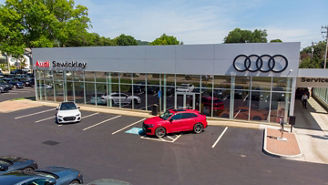
Audi Sewickley is at 526 Ohio River Blvd, Sewickley, PA 15143, part of the Ken Ganley Auto Group. Service and parts are open Monday through Friday; call 412-324-6685 for a winter check, or 412-324-2509 to book a winter test drive.
Every season is quattro® season.
See every new Audi quattro® SUV in stock at Audi Sewickley, or book a winter service check before the first storm.
Audi Sewickley